How To Make Money On Playstore Apps: The Ultimate Hybrid Guide
How To Make Money On Playstore Apps: The Ultimate Hybrid Guide
In the competitive digital ecosystem, launching a mobile application is only the first step toward commercial success. Transforming your source code into a profitable digital asset requires a calculated business approach. Therefore, understanding How To Make Money On Playstore Apps involves selecting a monetization strategy that matches your app’s purpose and your target audience.
Because a single revenue source is rarely enough to sustain long-term operations, most modern developers use a hybrid monetization model. Permanently, Google provides an extensive ecosystem of native features to help you build a predictable revenue stream. Below, we explore the primary pathways to monetize your Android software assets effectively
I. In-App Advertising: The Freemium Baseline
This approach is undeniably the most common path for free apps and games on the market today. You integrate an ad network—most commonly Google AdMob—to display ads directly inside your software layout. However, to keep your app reviews positive, you should balance revenue with user experience by choosing the right format carefully.
1. Rewarded Video Ads
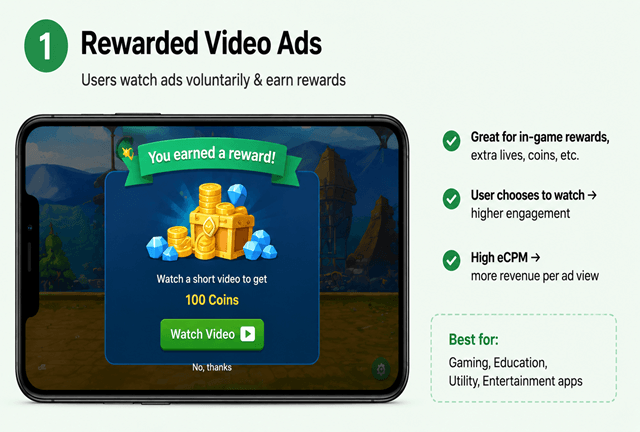
Specifically, users explicitly opt-in to watch a 15-to-30-second video ad in exchange for a premium incentive. This incentive could be an extra life in a game or unlocking a specific test level in an educational app. In fact, this format yields the highest user satisfaction and excellent eCPM (effective cost per mille) metrics
2. Interstitial Ads
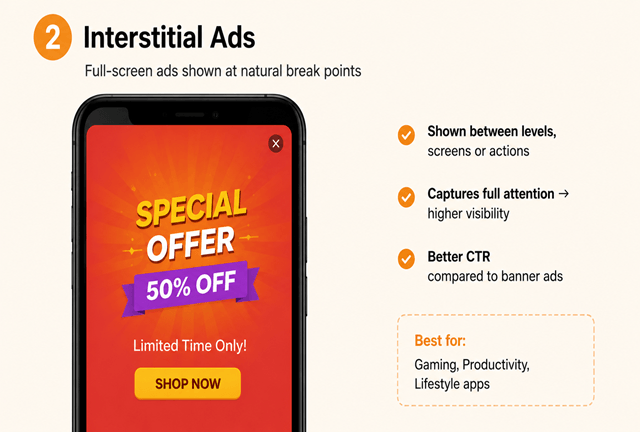
These are full-screen ads that transition dynamically between user tasks inside the software environment. For instance, they appear naturally when a user finishes a puzzle or moves from a configuration dashboard back to the main menu
3. Banner Ads
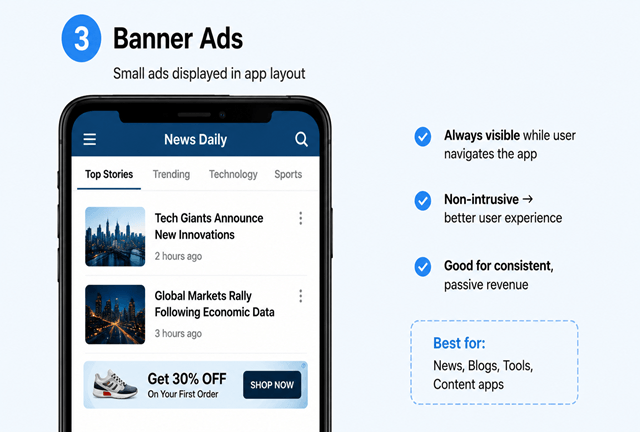
Alternatively, you can utilize smaller, persistent banner graphics. These are anchored permanently at the top or bottom of the screen layout throughout the user session
II. Realistic Monthly Earnings Math (The Trivia App Model)
Because trivia apps have multiple screens (Question à Answer à Scoreboard), users naturally trigger multiple ad impressions per session. Let’s assume a realistic scenario where you have 1,000 Daily Active Users (DAU) primarily based in West Africa. In this setup, each user plays a couple of rounds, seeing 2 full-screen interstitial ads and keeping a banner ad visible for a few minutes
1. The Impression Breakdown
Daily Interstitial Impressions: 1,000 users×2 ads=2,000 impressions per day
Daily Banner Impressions: 1,000 users×3 ad refreshes=3,000
impressions per day
2. The Payout Calculation

3. The Revenue Totals
Total Daily Revenue: $3.00+$0.90=$3.90 per day
Total Monthly Estimated Revenue: $3.90×30 days=$117.00 / month
III. Google Play In-App Purchases (IAP)
Instead of forcing users to buy your app blindly upfront, you can let them download it for free and sell digital goods inside using Google Play’s commerce engine. Consequently, you reduce the barrier to entry while opening up scalable spending tiers.
- Consumable Products: These are digital items that a user buys, uses up, and can buy again. Examples include in-game currencies, extra formatting credits, or one-off document generation tokens.
Non-Consumable Products: These represent permanent upgrades that a user buys exactly once. This is perfect for a premium “Remove Ads” button or unlocking access to a permanent structural feature within your too
IV. Subscriptions: Predictable, Recurring Revenue
If your application provides ongoing value, subscriptions are considered the industry gold standard. This applies directly to software with continuous content drops, cloud database syncing, or complex utility tools.
To implement this, you can set up flexible weekly, monthly, or annual auto-renewing cycles straight from the Google Play Console.
Pro-Tip: Make sure to utilize Google’s native subscription recovery tools. Google allows an extended subscription recovery period of up to 60 days to minimize churn. This feature automatically lets users seamlessly update declined or flagged payment methods without losing access to your services
V. Premium (Paid) Apps For Niche Software
Under this model, you set a fixed download price that the user must pay in the Play Store before downloading the application. This model works best for highly specialized, professional system utilities or premium offline games where users demand a 100% ad-free experience right out of the box.
As a general rule, paid apps naturally receive fewer downloads than free apps. As a result, making strategic app store optimization (ASO) and maintaining strong marketing lists are absolutely crucial to driving initial conversion rates
VI. Google Play Pass Royalty Pools
Once your application has established a track record of high quality, strong engagement, and low battery drain, you can apply to join Google Play Pass. This subscription service gives subscribers zero-ad, fully unlocked access to a curated catalog of premium apps.
By participating, you do not charge users directly. Instead, Google distributes a monthly royalty payout to participating developers based on a complex algorithm tracking user engagement and active time spent inside your app
VII. Important Platform Fees And Policy Changes
Understanding how Google splits revenue is key to planning your application’s business model over time. Indeed, platform policies change rapidly, and you must design your financial projections around them
1. Understanding the 15% Tier And New Fee Frameworks
For the vast majority of developers, Google charges a standard 15% service fee on your first $1M (USD) of total earned revenue each year. Furthermore, automatically renewing subscriptions are also locked at a baseline 15% service fee, keeping more profit in your development account
2. Expanded Billing Choice
Google has evolved its business model to offer expanded billing choice to global creators. Depending on your user’s region—such as the US, UK, and EEA—you can integrate an Alternative Billing System right alongside Google Play billing. In addition, you can utilize External Web Links to guide users straight to your website to complete a purchase.
Ultimately, when doing this, the standard platform fees are unbundled. This drops your core service fee to 10% for your first $1M of earnings, plus a localized billing framework fee, which is typically 5% in regions like the US/UK. In short, this grants developers massive flexibility in how they handle their user checkout funnels.
For a comprehensive, step-by-step walkthrough on how to leverage these native platform frameworks, implement alternative checkout flows, and configure your global pricing structures, check out the official Monetize with Google Play Commerce Video Guide. This session provides the exact setup guidelines, policy breakdowns, and toolkit strategies required to successfully scale your application’s transaction flow worldwide.